One Is Too Many
September Always Holds Its Breath
Every year, as uniforms come out of storage and timetables go back up on classroom walls, Hong Kong quietly braces itself. September is supposed to be a season of beginnings. But for too many young people, it arrives instead as a season of dread — filled with new expectations, old comparisons, and the private, exhausting arithmetic of whether they can keep up. Tragically, the news we most fear tends to cluster in these very first weeks back.
This World Suicide Prevention Day, the global theme remains “Changing the Narrative on Suicide”, with a call to action that is disarmingly simple: Start the conversation. At KELY Support Group, we want to be precise about the specific conversation Hong Kong is still avoiding — and highlight the ones already happening, completely unsupported, in classrooms and group chats across our city.
The Number That Should Stop Us
In late July, The Samaritan Befrienders Hong Kong released the city’s 2025 suicide mortality data. On the surface, the headline read like progress: 1,019 deaths by suicide, a rate of 13.57 per 100,000 people, down from 1,138 deaths and a rate of 15.1 in 2024 — marking the lowest overall rate since 2020.
Then you look at our children. Among those aged 19 and under, deaths rose from 35 to 47 — a sharp increase of over 30 per cent in a single year, pushing the youth suicide rate to 4.72 per 100,000, the highest in nearly a decade. It was the only age group in Hong Kong to record a significant rise. Separately, the Coroner’s Court confirmed 46 deaths among those aged 10 to 19, up from 34 the year before, also a ten-year high. Between 2021 and 2025, an estimated 141 primary and secondary students in Hong Kong took their own lives.
The tide is going out for the city as a whole, and coming in for its children.
The Samaritan Befrienders described this pattern as “overall stabilising, locally worsening.” At KELY, we would put it more bluntly: whatever is beginning to work for Hong Kong as a whole is simply not reaching our young people. This is not a story about a city that failed to care. It is a story about prevention that arrives far too late, and far too distant from where young people actually live their daily lives.
What the Pressure Actually Looks Like
When you ask students themselves, the picture sharpens immediately. In a survey of 5,551 secondary students, 42.6% reported high stress at the start of the school year, rating their anxiety between 7 and 10 out of 10. Nearly two-thirds ( 62.7%) admitted they were not excited about returning to school at all. Their primary struggles were clear: curriculum and coursework (63.2%), sleep and health (55.3%), and relationships and belonging (37.8%).
Anxiety scores averaged 25.4, a five-year high, with 27.8% showing mild to severe anxiety. Form 6 students facing the DSE scored highest of all, with worries almost entirely fixated on performance: declining grades (43.0%), loss of motivation to learn (36.7%), and the sheer volume of homework and assessments (34.8%).
Here is the detail that should unsettle every adult reading this: In the same survey, 94% of those students said they always or often arrived at class on time, and 87.9% submitted their assignments on time.
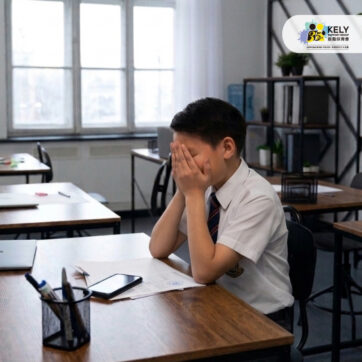
Distress in Hong Kong’s young people is rarely loud or disruptive. It is compliant. It hands the homework in on time. A young person can be drowning on the inside while looking, from the front of the classroom, like they are managing beautifully.
The First One by Their Side Is Often Just a Teenager
If pressure were the whole story, we would simply need better timetables. The harder problem is that young people under immense pressure are not reaching out to adults.
59.6% of secondary students rarely or never sought support when struggling, and 65.4% had never reached out to any formal individual or organisation.
KELY’s Youth Mental Health Survey also found that 60% of young people choose to bear the burden alone when facing mental health challenges.
While 41.4% of students are willing to confide in their friends, fewer than three in ten (28.5%) are willing to speak to an adult.
Most strikingly, KELY's research shows that 62% of surveyed young people aged 14 to 24 state that the first person they want to turn to when facing a problem is always a friend, rather than their parents, teachers, or professionals.
The first responder in a youth mental health crisis is almost always another young person.
This is the conversation Hong Kong is missing. We spend immense energy asking how to get young people onto counsellors' couches or hotline queues. Meanwhile, the disclosure has already happened — at lunch, on the MTR, or at 1 AM in a group chat. It has landed on a fifteen-year-old with no training, no boundary-setting skills, and no idea what to do with what they have just been told. That teenager carries the secret alone, terrified of betraying a friend's trust, often at a severe cost to their own mental health.
For Youth, By Youth: Moving Beyond Awareness
KELY has never treated youth suicide as an awareness problem alone. Years ago, we launched #OneIsTooMany, a youth suicide prevention campaign built around a public pledge. It asked adults and peers to commit to concrete habits rather than vague sympathy: connect meaningfully with at least one young person for 15 minutes a week, spend five minutes a day checking in with yourself, and learn the language of safe conversations.
This year, we are bringing it back. Not out of nostalgia, but because the data has made its central claim urgent again. When youth suicide hits a ten-year high in a year the rest of the city is improving, the phrase “one life lost is one too many” stops being a slogan — it becomes an urgent moral standard.
Pledges are the doorway, but structural education is the room. Since 2014, our Talk2Me Peer Supporter Training Certificate Programme has trained young people to become the safe, grounded support their friends are already seeking. Through 10 hours of hands-on training across five modules, we cover youth mental health literacy, emotional awareness, active listening, risk recognition, boundary-setting, and safe referral pathways to professional help. We train over 150 young people each year.
We are explicit about what this is not: we do not train teenagers to be counsellors. We train them to notice distress, listen without flinching, stay present, and act as a bridge to professional help. The results speak for themselves:
100% reported learning effective active listening skills
96% felt confident using those skills with peers
98% recognised the importance of processing all emotions
95% understood healthy coping mechanisms
This is what "for youth, by youth" means in practice. It is not treating youth as passive recipients of adult lectures, but empowering them as trained, supported, and boundaried first responders in their own communities.
Where We Go From Here: A Call to Action
Embed Social and Emotional Learning (SEL) into core curriculum: Universal, age-appropriate SEL and peer support training should be a standard part of secondary education for every student, not an optional extra dependent on a school's spare budget or a passionate teacher.
Fund primary prevention as seriously as crisis response: Mechanisms like the Three-Tier Emergency System are vital, but they only activate after a student is already in acute distress. Youth-focused NGOs working inside schools need formal, sustained funding for universal prevention — where success often looks like "nothing happening".
Change how we ask as adults: Only 28.5% of students feel comfortable talking to adults about their feelings. That is not a critique of youth; it is feedback for us. Ask about the person, not their grades. Learn to sit quietly with an answer you cannot immediately fix, without making them manage your panic on top of their own pain.
How You Can Be Part of the Solution?
You do not need a clinical degree to save a life. You just need to be reachable, present, and willing not to flinch.
15 Minutes a Week: Put your phone down and spend 15 unhurried, agenda-free minutes connecting with a young person in your life.
5 Minutes a Day: Check in with your own mental health, because you cannot hold someone else steady if you are losing your own footing.
Learn the Words: Asking directly and calmly if someone is thinking about suicide does not "plant the idea" — it lifts an unbearable silence.
One is too many. 47 young lives in a single year is not a statistic to be managed. It represents 47 families, and dozens of friend groups carrying an immeasurable burden. Not one of those deaths was inevitable, and no single organisation can solve this alone. It takes a whole community — and we are far stronger when we stand together.
If You Are Struggling Right Now
Please know that you are not a burden, and you do not need to have the "right" words ready to ask for help.
Emergency (Police or Ambulance): 999
The Samaritans (24-hr bilingual): 2896 0000
The Samaritan Befrienders Hong Kong: 2389 2222 (Cantonese) / 2389 2223 (English)
Suicide Prevention Services: 2382 0000